2026 Estimated Tax Calculator for Freelancers & 1099 Workers
Answer a few simple questions. We'll tell you exactly what to pay each quarter, in plain English, in under 2 minutes.
By the Easy Guides Editorial Team
Estimated Tax Calculator
This calculator uses the IRS safe harbor rule: pay 100% of last year's total tax (110% if you were a higher earner) and the IRS cannot charge an underpayment penalty, no matter how your income changes this year. Enter last year's number to get your penalty-safe quarterly payment.
Find this on your prior-year Form 1040, line 22 (total tax). It is not your refund or your balance due.
Higher earners use 110% of last year's tax as the safe-harbor target instead of 100%.
Withholding from a W-2 job, a pension, or Social Security counts toward your total. Leave at 0 if you have none.
Full calculator pageHow the safe harbor rule worksAll quarterly due dates
Federal estimate for educational purposes only, not tax advice. The safe-harbor method shown here protects you from underpayment penalties; your actual tax owed at year end may be higher or lower depending on your real income. Most states require separate estimated payments. Consult a tax professional for your situation.
What estimated taxes actually are
When you work a regular job, your employer withholds income tax from every paycheck and sends it to the IRS on your behalf. When you're self-employed, freelancing, or earning income outside of a W-2 job, no one does that for you. The IRS expects you to pay as you earn, four times a year.
Miss these payments, or pay too little, and the IRS charges an underpayment penalty. The good news: there's a simple formula called the safe harbor rule that lets you calculate your payments in advance and avoid any penalty entirely, even if your actual income turns out different from what you expected.
That's what this site is for. No jargon, no guesswork. Just the number you need to pay, and when to pay it.
Who needs to pay estimated taxes?
You generally need to make quarterly estimated tax payments if you expect to owe at least $1,000 in federal taxes for the year and your withholding won't cover it. This includes:
- Freelancers and independent contractors, Anyone receiving 1099-NEC income for services
- Self-employed business owners, Sole proprietors, LLCs, and partners in a partnership
- Landlords, Rental income is taxable and often not subject to withholding
- Investors, Capital gains, dividends, and stock option exercises can trigger quarterly obligations
- W-2 employees with side income, If your employer withholding doesn't cover your total tax liability
- Retirees, Pension, IRA distributions, and Social Security income may require estimated payments
If none of the above applies, if you have a single W-2 job with no significant outside income, you likely don't need to pay estimated taxes. Your employer's withholding handles it.
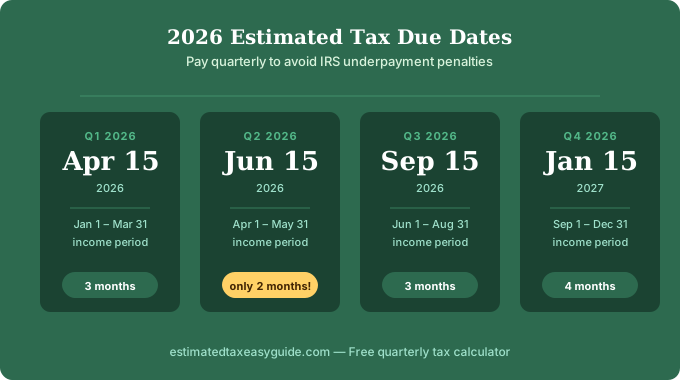
2026 estimated tax due dates
The IRS requires four payments per year. Mark these dates now:
Note that Q2 covers only two months, April and May, so the gap between Q1 and Q2 payments is shorter than it looks. Use our calculator above to get your exact payment amount for each deadline.
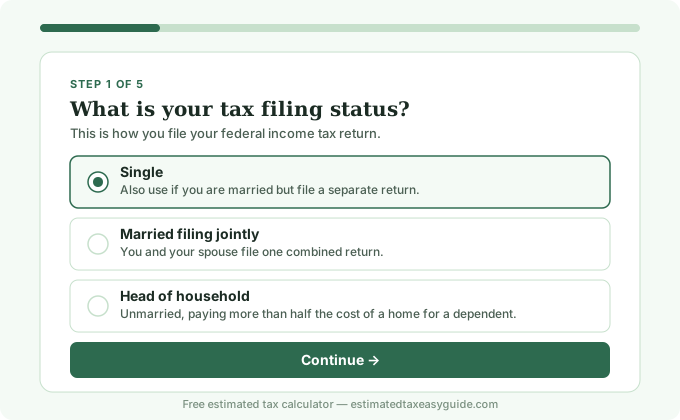
How the calculator works, answer 5 simple questions, get your exact quarterly payment
Quick answers to common questions
Estimated tax guides
Common questions
What are estimated taxes?
Estimated taxes are quarterly payments you make to the IRS when no employer is withholding taxes from your income. This applies to freelancers, self-employed workers, landlords, and anyone with significant investment income.
When are estimated tax payments due?
There are four due dates each year: April 15, June 15, September 15, and January 15 of the following year. If a date falls on a weekend or holiday, the deadline moves to the next business day.
How much should I pay each quarter?
The safe harbor rule: pay either 100% of last year's tax liability (110% if your income exceeded $150,000) or 90% of this year's expected tax. The calculator on this page figures this out for you automatically.
What happens if I miss an estimated tax payment?
The IRS charges an underpayment penalty, currently calculated at the federal short-term interest rate plus 3%. It is not catastrophic, but it is entirely avoidable by paying on time or using the safe harbor method.
Keep going
- → → How to calculate estimated taxes step by step
- → → Self-employment tax: what it is and how to reduce it
- → → Safe harbor rules, the easiest way to avoid penalties
- → → Estimated taxes for freelancers and 1099 workers
- → → What to do if you missed a quarterly payment
- → → Estimated taxes for landlords and rental income
- → → How to set up EFTPS for automatic payments
- → → Estimated taxes when you have both W-2 and 1099 income